


The United Nations Stabilization Mission in Haiti (MINUSTAH) officially ended its activities on Thursday, October 5, 2017, with a closing ceremony held in the evening at Camp General Jaborandy, in Tabarre. This ceremony took place in the presence of Haitian officials, including the President of the Republic, His Excellency Jovenel Moise, as well as members of the government, the Haitian parliament, the judiciary, as well as diplomatic representations in Haiti, the United Nations country team, Haitian civil society, alongside the Special Representative of the Secretary-General of the United Nations in Haiti (SRSG) and head of MINUSTAH, Sandra Honoré.
"In order to learn lessons and avoid a repeat of history, let us not forget that when MINUSTAH was deployed in June 2004, Haiti was in a state of profound institutional instability and criminal violence. The country was led by a provisional government, the Parliament was dysfunctional, and the Superior Council of the Judiciary did not exist," the SRSG began by recalling.
Welcoming the presence of the authorities and personalities present at this celebration which marks the closure of the United Nations Stabilization Mission in Haiti (MINUSTAH), in accordance with Security Council Resolution 2350 of April 2017, Sandra Honoré expressed her deep respect to all representatives of current and former governments, Parliament, representatives of the judiciary and elected officials at all levels of the State, civil society and the private sector, diplomatic and consular corps, civilian, police and military colleagues of MINUSTAH, as well as colleagues from the United Nations system who have contributed to the achievements in the field of security, stabilization and institutional strengthening since the establishment of MINUSTAH a little over 13 years ago.
"It is thanks to your dedication and tireless commitment that Haiti today can look forward to a more stable and secure environment that has made possible the closure of MINUSTAH and the transition to another configuration of the United Nations presence in Haiti," she said.
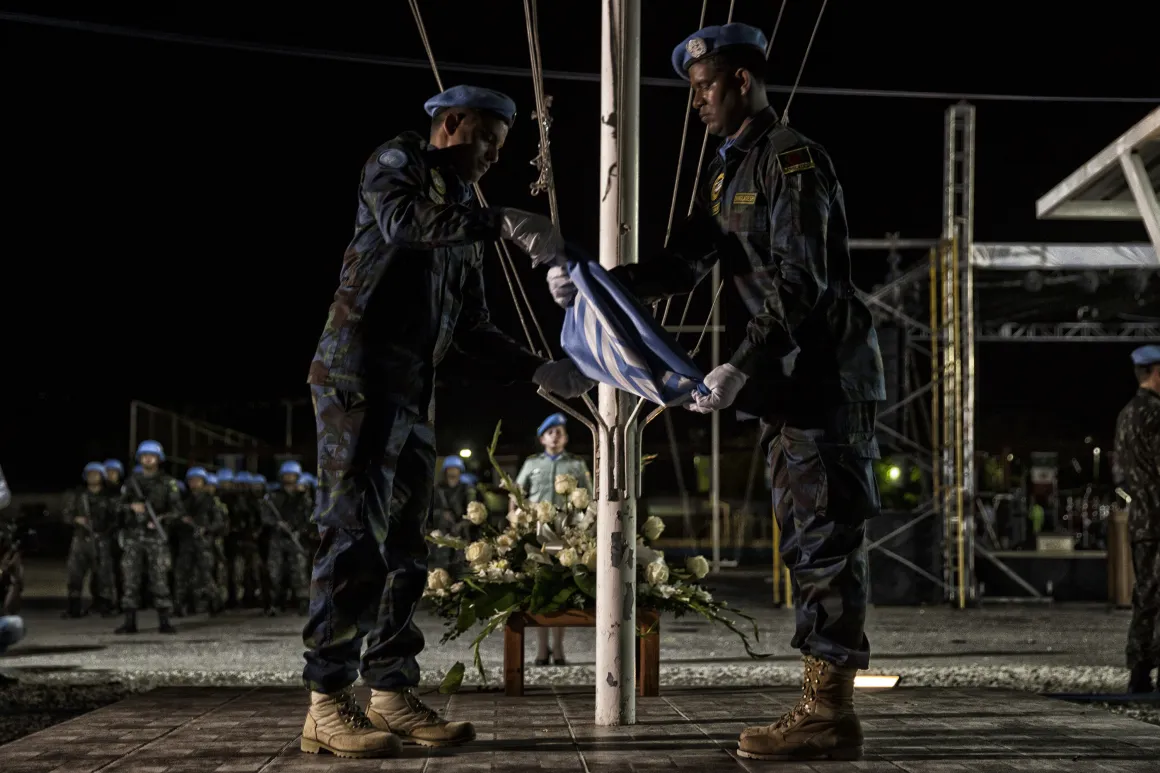
Photo: Logan Abassi UN/MINUSTAH
13 years of presence with successive mandates adjusted to the needs of the situation
Established on April 30, 2004, by United Nations Security Council Resolution 1542, MINUSTAH is the seventh United Nations peacekeeping mission in Haiti. Its mission is to create a secure and stable environment to enable Haitian authorities to restore state authority throughout the country and reestablish democracy and the rule of law. Since then, mandates adapted to the evolving situation have been renewed annually.
MINUSTAH pursued four main objectives: the establishment of a secure and stable environment, political stability through the strengthening of democracy, including through electoral assistance, the development and professionalization of the Haitian National Police and the restoration and maintenance of the rule of law, including through the promotion and protection of human rights.
"13 years later, Haiti now has an elected President of the Republic in office, a functioning Parliament, an existing Judicial System, the Police are professionalized with a staff of 14,000 officers and the population is experiencing a much better level of security and stability," emphasized Sandra Honoré.
For his part, the President of the Republic of Haiti, His Excellency Mr. Jovenel Moise addressed his words of thanks to the United Nations for its support to the Republic of Haiti during the 13 years of support to the National authorities through the various components of MINUSTAH.
"I ask you, Madam Special Representative of the Secretary-General, to convey, on my own behalf and that of the Haitian people, my sincere thanks to the member countries that have contributed their material and human resources, including troops and police officers necessary for the accomplishment of MINUSTAH's mission. And finally, allow me, Madam Special Representative, to express my thanks for your contribution to the political stabilization in Haiti and the professionalization of the Haitian National Police," declared the Haitian Head of State.
Mr. Moise said he was aware of the persistence of some pockets of political and social tension, while expressing confidence that Haitian political actors are aware of their civic and patriotic duty to create a climate of political and social stability in their country.
"As responsible statesmen and women, we Haitians are called upon to draw on the reserves of patriotism and civic-mindedness, the lessons of history to promote Têt ansanm and the konbit nasyonal with a view to strengthening democracy and consolidating social peace in our dear Haiti," affirms the President of the Republic of Haiti, who believes that there is no sacrifice too great for political stability in Haiti.
Civil society torn between pride and awareness of challenges
"As a Haitian, it is with a sense of pride that I attend this ceremony where MINUSTAH hands over the destiny of our country to us. Of course, we cannot boast of a 100% positive assessment because there is still much to do. But we can note great progress in the areas of justice, the rule of law, and political stability," says Raphaëlle Jeorveline Barreau Bateau, coordinator of the Young Haitian Parliamentarians network and president of the Passion and Self-Love Organization (PAS).
Speaking on behalf of young people, Raphaëlle expressed her gratitude to MINUSTAH for its involvement in the fight for the supervision and integration of Haitian youth and respect for women's rights, among other things. "But after all, we are a sovereign people, MINUSTAH has played its role for thirteen years, it is up to us Haitians to take over now," she believes.
Raphaëlle Jeorveline Barreau is not the only one to recognize the progress made by the country in the areas mentioned above by the speakers who took to the podium. Kenley Talmer, project officer at the Center for the Promotion of Democracy and Participatory Education (CPDEP), believes that this ceremony marks an important milestone in the history of her country.
"In 2004, Haiti experienced a chronic political crisis with all that entailed in terms of violence and crime. Today's ceremony signifies that the presence of the United Nations has borne fruit," said Kenley, a civil society member.
For him, the event also marks the Haitian leaders' willingness to take over and avoid a repeat of history. On behalf of the CPDEP, Kenley commends MINUSTAH's work on behalf of young people. This work aims in particular to engage Haitian youth in promoting good governance and the sustainable development of Haitian society. "For our part, we are committed to continuing the work of spreading good governance that we have begun with the support of MINUSTAH through its political affairs unit," he concludes.
Antonal Mortimé, a human rights activist in Haiti and co-director of the human rights promotion and defense organization known as "Collectif Défenseurs Plus" agrees. For him, the overall assessment is positive, but there is still much to be done to put Haiti on the path to stability, especially in the area of human rights. He refers to the four objectives of the first resolution (1542) establishing MINUSTAH in Haiti. "I believe that some of these objectives have been achieved, such as the holding of elections (2006, 2010-2011, 2015 and 2016), the pacification of working-class neighborhoods rife with violence, etc.", acknowledges the human rights defender. Furthermore, Mr. Mortimer emphasizes that MINUSTAH has been involved in stories that have negatively affected the Haitian population. He refers in particular to cases of sexual violence and the cholera epidemic. "I believe that the United Nations system should work on this aspect to give a more positive image of the UN in Haiti," advocates Antonal Mortimé.
Like members of civil society and Haitian authorities, the head of MINUSTAH recognizes that much remains to be done for Haiti to achieve the stability and sustainable development to which everyone aspires. "The achievements of the thirteen-year period that is ending must be amplified, and it is to take this reality into account that the United Nations Security Council decided in its resolution 2350 of April 2017 to end the mandate of MINUSTAH on October 15 and to establish MINUJUSTH, a smaller Mission whose operations begin on October 16," recalls the head of MINUSTAH.
"I sincerely hope that Haiti will seize the opportunity offered by MINUJUSTH to consolidate the gains made in stabilization in recent years and to implement reforms aimed at strengthening the rule of law and human rights," concluded the woman who has led the United Nations Stabilization Mission in Haiti since July 15, 2013.
Written by: Marie Yolette B. Daniel

