

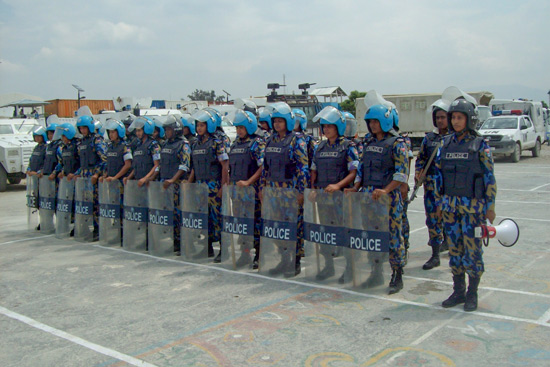
106 women police officers from Bangladesh are working in Haiti at ensuring the safety of Pétionville IDP camp in the Haitian capital, where they are patrolling alongside with officers of the National Police
.
“One of the advantages of being a woman is that when we are on duty in the IDP camps, children and females find us more approachable when it comes to reporting incidents and complaint”, says the commander Shahina Amin, head of the contingent BANFPU-2.
For her, being a female in the mission can be a mixed experience, both challenging and rewarding. “We are neck and neck with other contingents and other units as far as professionalism and dedication. And there is no difference in the type of duty we perform,”she explains.
 “It’s not easy, but if I did not enjoy my work, I would not be here. Our presence is good exposure for other women, so they might be encouraged to contribute their skills to the UN”, she adds.
Mother of two children, Commander Amin is also proud that one of her daughters has recently presented her work with the United Nations in a project for school.
“The hardest part is being away from home”, she says, noting that travel to Bangladesh takes two days and a 30-hour flight. “This is why the support of my husband is vital”, she says. "He takes care of the children and it is a great sacrifice."
Superintendent of Police in her own country, she worked in 2009 in another United Nations Mission, in Kosovo (UNMIK),with the special police unit of her contingent.
“It’s not easy, but if I did not enjoy my work, I would not be here. Our presence is good exposure for other women, so they might be encouraged to contribute their skills to the UN”, she adds.
Mother of two children, Commander Amin is also proud that one of her daughters has recently presented her work with the United Nations in a project for school.
“The hardest part is being away from home”, she says, noting that travel to Bangladesh takes two days and a 30-hour flight. “This is why the support of my husband is vital”, she says. "He takes care of the children and it is a great sacrifice."
Superintendent of Police in her own country, she worked in 2009 in another United Nations Mission, in Kosovo (UNMIK),with the special police unit of her contingent.
 Here in Haiti, in addition to patrolling the IDP camp, the Bangladeshi police also deal with medical emergencies.
In their headquarters, near Camp Delta, they maintain small gardens of flowers and vegetables. “These gardens make the unit ‘more green’ and more independent,”says Commander Amin.
Apart from the food, all equipment and supplies come from Bangladesh, from carpets and curtains to weapons and generators. A prime example of gender mainstreaming, the unit, composed of 106 operational women, also benefits from the support of 54 men, cooks and drivers.
Bangladesh has deployed several contingents in UN missions across the world, in Sudan, Darfur and Côte d'Ivoire. It also provides two of the three female-only police units currently operating, in the Democratic Republic of Congo. The third is a unit from India, deployed in Liberia.
Here in Haiti, in addition to patrolling the IDP camp, the Bangladeshi police also deal with medical emergencies.
In their headquarters, near Camp Delta, they maintain small gardens of flowers and vegetables. “These gardens make the unit ‘more green’ and more independent,”says Commander Amin.
Apart from the food, all equipment and supplies come from Bangladesh, from carpets and curtains to weapons and generators. A prime example of gender mainstreaming, the unit, composed of 106 operational women, also benefits from the support of 54 men, cooks and drivers.
Bangladesh has deployed several contingents in UN missions across the world, in Sudan, Darfur and Côte d'Ivoire. It also provides two of the three female-only police units currently operating, in the Democratic Republic of Congo. The third is a unit from India, deployed in Liberia.
Photo : Mélanie Malenfant - UN/MINUSTAH |
 “It’s not easy, but if I did not enjoy my work, I would not be here. Our presence is good exposure for other women, so they might be encouraged to contribute their skills to the UN”, she adds.
Mother of two children, Commander Amin is also proud that one of her daughters has recently presented her work with the United Nations in a project for school.
“The hardest part is being away from home”, she says, noting that travel to Bangladesh takes two days and a 30-hour flight. “This is why the support of my husband is vital”, she says. "He takes care of the children and it is a great sacrifice."
Superintendent of Police in her own country, she worked in 2009 in another United Nations Mission, in Kosovo (UNMIK),with the special police unit of her contingent.
“It’s not easy, but if I did not enjoy my work, I would not be here. Our presence is good exposure for other women, so they might be encouraged to contribute their skills to the UN”, she adds.
Mother of two children, Commander Amin is also proud that one of her daughters has recently presented her work with the United Nations in a project for school.
“The hardest part is being away from home”, she says, noting that travel to Bangladesh takes two days and a 30-hour flight. “This is why the support of my husband is vital”, she says. "He takes care of the children and it is a great sacrifice."
Superintendent of Police in her own country, she worked in 2009 in another United Nations Mission, in Kosovo (UNMIK),with the special police unit of her contingent.
 Here in Haiti, in addition to patrolling the IDP camp, the Bangladeshi police also deal with medical emergencies.
In their headquarters, near Camp Delta, they maintain small gardens of flowers and vegetables. “These gardens make the unit ‘more green’ and more independent,”says Commander Amin.
Apart from the food, all equipment and supplies come from Bangladesh, from carpets and curtains to weapons and generators. A prime example of gender mainstreaming, the unit, composed of 106 operational women, also benefits from the support of 54 men, cooks and drivers.
Bangladesh has deployed several contingents in UN missions across the world, in Sudan, Darfur and Côte d'Ivoire. It also provides two of the three female-only police units currently operating, in the Democratic Republic of Congo. The third is a unit from India, deployed in Liberia.
Here in Haiti, in addition to patrolling the IDP camp, the Bangladeshi police also deal with medical emergencies.
In their headquarters, near Camp Delta, they maintain small gardens of flowers and vegetables. “These gardens make the unit ‘more green’ and more independent,”says Commander Amin.
Apart from the food, all equipment and supplies come from Bangladesh, from carpets and curtains to weapons and generators. A prime example of gender mainstreaming, the unit, composed of 106 operational women, also benefits from the support of 54 men, cooks and drivers.
Bangladesh has deployed several contingents in UN missions across the world, in Sudan, Darfur and Côte d'Ivoire. It also provides two of the three female-only police units currently operating, in the Democratic Republic of Congo. The third is a unit from India, deployed in Liberia.
